Black Widow Spiders in Lake Elsinore: Where They Hide, How Dangerous They Are, and What to Do
Black widows are one of the most common calls Main Sail Pest Control receives from Lake Elsinore homeowners – and one of the most anxiety-producing discoveries a homeowner can make. That anxiety is reasonable. Black widows are genuinely venomous and genuinely present throughout the Elsinore Valley, particularly in the conditions that describe most residential properties in this part of Southern California. Knowing where they actually live, how to identify them with confidence, and what actually reduces their presence is more useful than a general warning to “watch out for spiders.” Lake Elsinore’s climate and terrain make black widows a persistent reality, and the best response is accurate information rather than fear.
Why Lake Elsinore Is Prime Black Widow Territory
The western black widow (Latrodectus hesperus) thrives in exactly the conditions that describe most of Southern California’s Inland Valley: warm temperatures, dry summers, limited humidity, and an abundance of the insects they prey on. The Elsinore Valley’s location – surrounded by hillside chaparral that supports large populations of insects and spiders – means the prey base that sustains black widow populations is consistently present.
What separates Lake Elsinore from coastal communities is the intensity of the dry heat. Black widows do particularly well in environments where temperatures stay warm enough year-round that they remain active and reproductive even through winter months. Unlike areas where hard frosts drive populations down, the Inland Valley gives black widows conditions for nearly year-round breeding. Established populations in and around residential structures don’t experience the same winter die-off that limits their numbers in cooler regions.
New construction neighborhoods around the lake and the hillside developments that have expanded significantly over the past decade introduce another factor: land clearing and grading disturbs existing spider habitat and pushes populations toward the structures that replace it. Homes built in areas that were previously open terrain inherit a higher initial pest pressure, including black widows, simply because the habitat was already occupied before construction began.
Where Black Widows Actually Live Around Your Home
Understanding black widow habitat is what makes inspections useful and prevention realistic. These spiders don’t live in the middle of rooms or in open, well-trafficked spaces. They prefer sheltered, undisturbed locations with low light where they can anchor their irregular webs.
The most common locations in Lake Elsinore residential properties:
Garages – particularly along the floor-wall junction, behind stored items, in corners where boxes or containers have been sitting undisturbed, and underneath workbenches or shelving units. A garage that hasn’t been fully cleared and cleaned in several months is essentially ideal black widow habitat.
Outdoor furniture – the underside of plastic or metal outdoor chairs and tables, particularly furniture that sits against a wall or fence. Black widows build webs on the underside of flat surfaces that protect the web from direct sun and wind.
Wood piles – firewood stacked against the house is one of the single highest-risk locations for black widow contact. The gaps between logs provide protected harborage, and the location adjacent to the home means foraging brings spiders into contact with the structure itself.
Block walls and stucco fences – the weep holes and voids in concrete block walls are significant black widow harborage sites. Block walls surrounding Lake Elsinore properties are among the locations most commonly overlooked during inspections.
Meter boxes and utility spaces – electrical meter boxes, irrigation controller housing, and other utility enclosures are sheltered, rarely disturbed, and connected to the exterior of the structure. These are consistent black widow habitats.
Identification: Black Widows vs. Brown Widows vs. Other Spiders
The spider identification question matters because Lake Elsinore also has brown widows (Latrodectus geometricus), which have established themselves throughout Southern California over the past two decades. Brown widows produce a distinctive spiky egg sac that looks like a small underwater mine. Their venom is considered more potent than the black widow’s, but they inject less of it and are less aggressive, making actual bites less severe in practice.
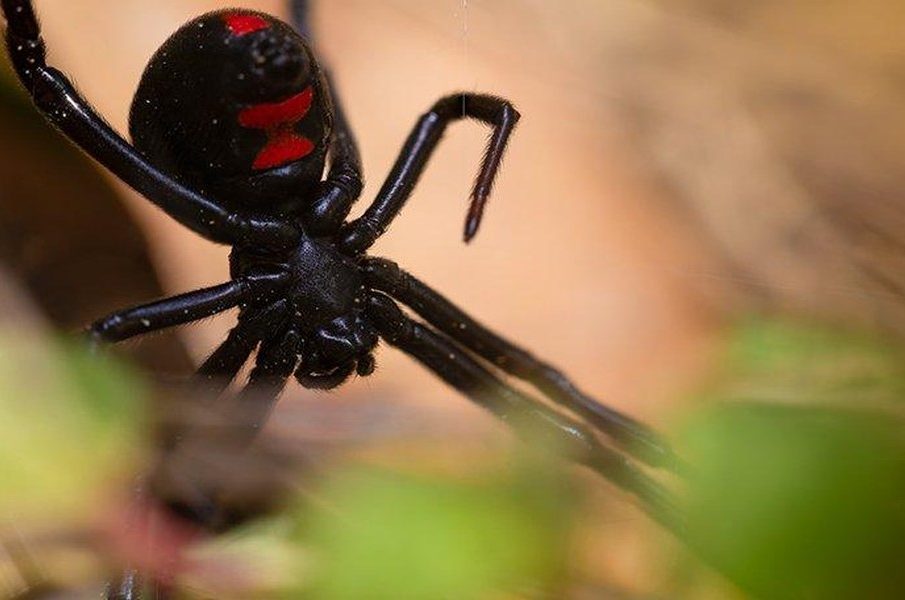
The western black widow female is the dangerous one. She is shiny black with the characteristic red hourglass marking on the underside of the abdomen – visible if you look at the spider from below. Adult females are roughly 1.5 inches in leg span. Males are smaller, lighter colored, and far less venomous; they’re also the ones that get killed and eaten after mating in the scenario most people imagine, though it doesn’t happen nearly as often in the wild as popular culture suggests.
The web itself is a reliable identifier: black widow webs are irregular, tangled, and strong – noticeably sturdier and stickier than the webs of most common household spiders. They’re built low to the ground or in dark corners rather than in the geometric orb-shaped patterns of garden spiders.
False black widows (Steatoda grossa) are commonly misidentified as black widows and are present throughout Southern California. They’re dark brown to black, similar in size, but lack the hourglass marking. They’re not medically significant. This is one reason visual confirmation before panicking is worth a moment’s attention.
How Dangerous Are Black Widow Bites, Realistically?
Black widow venom is a neurotoxin that affects the nervous system rather than destroying tissue the way brown recluse venom does. A bite from a female black widow can cause significant pain, muscle cramps (particularly abdominal), nausea, elevated blood pressure, and sweating. The medical term for the syndrome of symptoms is latrodectism.
Fatalities from black widow bites in the United States are extremely rare – the California Poison Control System receives hundreds of calls annually but deaths are documented in only a handful of cases historically, typically in very young children, the elderly, or those with compromised health. This doesn’t make a bite insignificant – the pain and symptoms can be severe enough to warrant emergency care – but the outcome with prompt medical attention is almost always full recovery.
The risk population in Lake Elsinore that warrants the most attention: young children who play in garages, near wood piles, or around outdoor furniture without supervision, and adults who reach into storage areas, grab firewood barehanded, or move outdoor furniture without checking the underside first.
What Actually Reduces Black Widow Populations Around Your Home
Eliminating harborage is the single most impactful homeowner action. Removing wood piles from direct contact with the house structure, decluttering the garage, sealing the underside of outdoor furniture against the wall, and clearing debris from the perimeter all reduce the number of protected locations black widows can occupy.
Professional exterior perimeter treatment addresses what individual cleaning efforts can’t reach – the wall-foundation junction, block wall voids, utility enclosures, and other structural harborage sites that aren’t accessible to regular cleaning but are consistent black widow habitats. Residual insecticide applications to these locations kill spiders that contact treated surfaces and reduce the prey insect population that sustains them.
The recurring treatment model is important here for the same reason it is with ants: residual products have a lifespan, and after it expires, a fresh population from the surrounding landscape will begin recolonizing the perimeter. A single one-time treatment produces results that are temporary relative to the ongoing pressure from Lake Elsinore’s natural surroundings.
When and How to Call Main Sail Pest Control
If you’ve found a black widow in or around your Lake Elsinore home – particularly inside the garage or in any location accessible to children – that’s a reasonable trigger for a professional inspection. A single spider in an accessible location isn’t necessarily the sign of a large infestation, but it is a sign that conditions around your home are suitable for black widows and that a perimeter assessment is worth conducting.
Main Sail Pest Control serves Lake Elsinore, Wildomar, Menifee, and the surrounding communities. We offer same-day service and free estimates. Contact us for an inspection to assess black widow activity around your property and set up the perimeter treatment that prevents them from establishing in the first place.

Leave a reply


-
Safer Outdoor Surfaces That Improve Both Style and Function
Outdoor spaces are essential in residential and business properties. These are spaces ... -
-
-
-